Buscando un concepto EDU.IT

“...el contexto sociotecnológico generen un nuevo modelo de escuela que responda a las necesidades formativas de los ciudadanos...” Adell Castañeda

Buscando un concepto EDU.IT (parte 2)

¿Cuál es la situación actual y cuál la deseada? ¿Cómo haremos realidad un proceso de innovación?

Learn to use the Core Google for Edu apps

Google offers a free-of-cost learning center for teachers that want to learn how to use GAFE. Learn at your own pace.

Documentar los proyectos como estrategia de aprendizaje

La documentación de procesos educativos está cobrando cada vez más importancia. Pero, ¿cómo comenzar a documentar? ¿Cuáles son las primeras consideraciones?

Personal information protection

Many websites gather personal information from their visitors. Some tips for beginners.

Saturday, January 21, 2017

Leadership in educational contexts

We live  making decisions, constantly. We like to think that humans make decisions rather rationally than emotionally, because it is tough that way, that humans are rational beings. Our culture has championed rational endeavors, more than emotional ones for a very long period in time. In fact, after the late modern period, entire history time periods are mainly ranged on science and technological progress or breakthroughs. It is not until post-modern time periods, rationalism and emotional factors together have being recognized as drivers of the vast majority of social systems. Social factors have became more prominent to the extent of supporting the idea of a technology development trend tightly coupled to social movements. Core philosophical concepts or ideas, such as "truth" or "real" -see Baudrillart and Kellner- transformed because of the symbiotic relation between technology and social changes.

Technology and social factors bending the truth. 
Here's a short example about how information age technologies affect social change.

I believe that that all social and technological game changer are driven by a number of different leaders -not a unique one- And every effecting change is always produced by a number of different leaders. According to an article found in Leadership-Central, leadership theorists agree on a detailed time line that begins with a "Great man theory" and then progress to some other "one man" leadership theories, only to finish with a more "distributed" concept of leadership and effecting change. In fact, post modern social theorists insist on the idea that social movements are affected by a number of concurrent factors, resulting in a fuzzy logic dynamics.

I support this affirmations  based on the concept of dynamic and chaotic systems. With the purpose of clarification, let me go into a very summarized intro to system dynamics. Chaotic systems are those highly sensitive to initial conditions. A very small variation on the initial conditions will create greatly divergent variants in system behavior, making impossible to cast long-term predictions. Take for instance voting predictions, as the voting process being a social and chaotic system in nature (a small variance in the initial variables, such as a small mathematical defect in the sample for vote intention polls, might affect the end result or prediction of the elected) Inside this kind of systems are what mathematicians call "strange attractors". Those attractors are subsets that seem to -literately- attract a number of similar results despite divergent initial states. Take a look at the following image:


The lines represent the general behavior of the chaotic system and the pattern you see in the image is caused by attractors. Different initial states will produce a different path each time, but all paths are shaped around the attractors, creating the pattern. This means that it is highly improbable to predict the exact path of a specific run, but it is highly probably correct to say that a specific run will show a given pattern.

Finally, this is what I think is leadership about in educational context. Leaders are attractors. Each of the lines or runs for the chaotic system can be a number of social entities: teachers, students, parents. This social entities will exhibit a specific behavior very difficult to predict, but within a given pattern produced by the leaders.

School leaders are not to create a deterministic context for edu actions to take place, but set the context for a multiverse set of actions withing an acceptance threshold, that is creating the conditions where different paths might converge to a desired pattern. Know that pattern will have fuzzy limits and it would look something like the above image, you´ll recognize the pattern appropriate for a school. Within the pattern a multitude of ways of thinking, a broad sense of reality and even some eccentric behavior paths should be accepted, in the name of cultural diversity. Jet again, you´ll recognize the pattern of a good school, when you see it.

For more detailed information:


Wednesday, January 11, 2017

This is my workplace

The new prompt of  #EDUBLOGSCLUB has made me reflect on the following: at the school where I work, we ask repeatedly our students to introduce the school to other parties, such as students in other countries. Sadfully, teachers do not do that very often. Once in a while, as we attend to conferences or workshops we find ourselves sharing basic information about our schools. Where do you work at? How many students attend to your school? What subject do you teach? or some other simpler questions are a commonplace.

At first it seems a simple task. A short text accompanied with a photograph and the job is done. Why should I invest time and effort on doing that, if someone has already done it for me? The straight forward solution would be to share the school website link: Colegio Goethe Buenos Aires.  Now, my purpose here is to share with you what my feelings about my workplace are. 

 I still remember very vividly the first impressions I had as I walked in for the first time. It was for the last interview of the admission process, but the first one on site. I drove my car to the address I was given, considering the recommendation to arrive ten minutes earlier to the meeting time. Security staff checked my ID and let me use a visitor parking slot. That was the outer perimeter. After a three or four minutes walk, I arrived to the front desk in a large hall. Behind that front desk, I was able to see a large campus, big buildings and large open spaces, lots of students wearing neat uniforms and staff people walking around. That picture did not match with the memories of the school I attended as a student, a modest paroquial  school.  Please, don't get me wrong, it was not intimidating, but I couldn't help thinking about school's infrastructure and educational outcomes. 

Finding my way to the principal's office for the  planned interview was easy, staff members were so helpful to accompany me all the way to my destination. A staff member was actually waiting for me at the front desk, she started a friendly chat that helped me to calm down. Sometime latter, I realized the job interview had already started at that point as I learned she was a human resources consultant. The friendly chat  lasted for about ten minutes and then she showed me to the principal's office. The atmosphere was very welcoming. I was offered the position and invited for a tour around the facilities.   

Why am I telling you this, that happened 18 years ago? Because I keep this in mind every day I go to work: it looks like a small corporation's facilities and infrastructure, but the people inhabiting this buildings create the most enjoyable learning and teaching atmosphere I've ever experienced. 

As an IT professional and a digital learning evangelist, I learned to pack my fix-location-office in  and moved it to the cloud. It was a tough decision that many did not understand nor support,  specially top management representatives. They argued that not having a fixed location to be easily reachable (the were thinking about not having an extension number to dial whenever they needed to communicate with me) would make me regret my decision not long after.  This was back in 2004. Technology was on my side,  educational and management trends  were also on my side and this idea of a cloud based office finally took off like one of the most powerful airliners ever ! (actually I feel like I`m selling tickets to this airliner now) So, I can take my job to whatever location inside the school I prefer to and I use this advantage in many ways. Do we need to catch up with project indicators? then, lets book a small meeting room. Do we need to exchange some ideas before a PTA? then, lets have a coffee at the students cafeteria. Do we need to have an educational chat with a student about FB or TW appropriate usage before it is too late? then, lets meet at the front desk and have a walk in the school park.

It sounds great, isn't it? There are two things that concur. The most important one, the school I work for has a very strong culture of student centered learning / teaching / management methodology. Although in my country (.ar) the school system in general has a very archaic shape, international schools like the one I work for, enjoy of a certain degree of flexibility. The second one, IT resources are not an issue. Students and staff members have access to a variety of devices to carry around during school time and an incipient BYOD initiative is also in place. Don´t think it is like the IT Disneyland, but we are certainly beyond the defining event in IT.    

Basically, I work paperless, but I do not "hate" paper... I just do not need it for the most part of my personal or professional life. There are a few exceptions, like certain printed information that I'm legally obligated to keep. There are also a few drawbacks: doing backups regularly is a mayor concern, I struggle to  achieve connectivity or power supply redundancy and device or software upgrades are a must.

Saturday, January 7, 2017

This is my blog story

Scrolling up and down my Twitter feeds I found one entry that immediately caught my attention,


At the moment I first read about the #EdublogsClub initiative, some basic questions arouse: Is this intended for beginners / amateurs or "professional" bloggers?  Is this my chance to develop a habit for blogging? I am currently on holidays, Will I have the time to sit down and think about the prompts?

That was like four days ago. I had the time to give it a thought. So, here I am, prompt 1: my blog story. I feel I have nothing more than a commonplace to write about prompt 1, so I decided not to bore you (if I happen to have a reader) Instead, I will make a confession: I´m here to learn from the community and to try (one more time) to develop a habit into blogging.

I am currently facing a crisis. Some time ago I found this quote by Umberto Eco:


I am an admirer of his work, he was one of the greatest thinkers of our era, and his words came down on me like a ton of bricks right on my head, until I learned about the impostor syndrome while reading Ronnie´s post "Should I blog or should I blog". Why wouldn´t I give it a try? Whether my posts are popular or not, my success indicator should be suitable to my learning process than to others expectations.  So, my challenge  would be to exceed my own current limitations and make a great effort to exit the comfort zone.

Thursday, July 21, 2016

SAMR or OSAMR


Dr. Ruben Puentedura is the creator of the SAMR model for selecting, using, and evaluating technology in education. The SAMR model is a way to reflect upon how you are integrating technology into your classroom. On the other hand, O-SAMR is an allegory to notice the barriers to integrate technology in education. 

Saturday, July 9, 2016

Rúbricas (nada como un ejemplo)

Hace unos días publiqué un artículo donde comparto algunas ideas iniciales sobre el uso de rúbricas. En aquel artículo propongo el uso de ese instrumento para "escapar" de la trampa que puede significar el mal uso de las calificaciones exclusivamente numéricas (o alfabéticas en algunos sistemas) En esta segunda parte, les acerco algunos ejemplos, a partir de los cuales ustedes podrán crear sus propias versiones.


Wednesday, July 6, 2016

Rúbricas !


There are a lot of common places to ditch grades, like "Grades don't determine intelligence, they test obedience" or "Too many teachers would use grades and points like weapons to force students into compliance. This is NOT about learning. It's control". Like there were any easy way out the system or any easy answer to the question, how to measure success / quality of work / learning progress of our students?  At a certain point, teachers are forced by the system to translate their human appreciation into a single number or a single letter.

Some initiatives deliberately question low grading as a tool for indicating failure (see more...), some other initiatives gradually introduce grading only when students turned 15 (see more...).  Two very different words converging into  one common educational core concept: students need to find motivation and joy in their learning process and, at the same time, be prepared for "the outside of schools". 


In my pursue for answers to these matters, I came across rubrics. Rubrics are scoring guides used to assess the quality of students´ constructed responses. They are developed considering a specific structure,  in the form of a matrix,  to provide students with informative text about quality expectations. Take a look at the following image, which is self-explanatory: 


The performance descriptors describe the relative differences between performances at each level. These descriptors are written in a simple straight forward way and they must be short. Good descriptors include: 
  • Specific aspects of the performance which will be different at different levels. For example: analyses the effect of …/describes the effects of … /lists the effects of …
  • Adjectives, adjectival phrases, adverbs and adverbial phrases are used where the aspects of a performance stay the same across the levels, but there is a qualitative difference to the performance. For example: - accurately explains/explains with some accuracy/explains with limited accuracy - provides a complex explanation/provides a detailed explanation/provides a limited explanation - shows a comprehensive knowledge/shows a sound knowledge/shows a basic knowledge.
  • Numeric references. Numbers identify quantitative differences between levels. For example, - provides three examples/provides two examples/provides an example - uses several strategies/uses some strategies/uses few or no strategies*

Sunday, July 3, 2016

Busca arte con Google


Google Arts & Culture es una gran colección de obras de arte, organizadas y presentadas en imágenes de alta calidad. El proyecto comenzó en febrero de 2011, en cooperación con numerosos museos y galerías de arte. Las obras y espacios de los museos e instituciones pueden ser visitadas, y en algunos casos, recorridos con explicaciones detalladas. Los visitantes del sitio pueden recorrer exposiciones, gracias a la misma tecnología que impulsa a StreetView. En la actualidad, el sitio permite explorar más de 32.000 piezas de arte digitalizadas, recorrer más de 151 museos y galerías.


La colección puede ser explorada utilizando las categorías preestablecidas: por nombre del artista, por tipo de medio, por movimiento artístico, por eventos históricos, por personalidades históricas y por lugares de referencia. También es posible crear una colección personal, seleccionando las obras de interés y agregándolas a una lista privada.
El visitante puede crear su propia colección de obras de arte. Sólo es necesario encontrar la obra buscada y marcarla como favorita. El sitio ofrece una herramienta para crear estas listas, las que luego pueden ser consultadas en línea y no será necesario sobrecargar nuestra lista de favoritos en el navegador. Las listas de favoritos pueden ser públicas o privadas del usuario, también es posible compartir una lista. Otra opción interesante es la posibilidad de compartir en redes sociales como G+ o Pinterest.

Accede al sitio del proyecto: https://www.google.com/culturalinstitute/beta/


Saturday, June 25, 2016

Buscando un concepto IT (Parte 2)


La planificación de las TAC (para una definición del acrónimo TAC, siga este enlace) es un factor clave de éxito en las instituciones educativas. Define el desarrollo de las competencias digitales y, si el nivel de integración en el currículo es elevado, redefine procesos de enseñanza y aprendizaje. Es un marco de referencia conceptual, que propone una forma de entender cómo formar alumnos para un futuro altamente tecnificado y mediado por dispositivos digitales. Al tiempo que, como instrumento de gestión, el plan TAC orienta los procesos de decisiones relacionados con campos como el pedagógico, infraestructura técnica, formación profesional docente, entre tantos otros. A la luz de estas ideas, es evidente la naturaleza transversal de sus definiciones.

El éxito de un plan estratégico con fuerte énfasis en TAC, depende de varios factores: requiere de un impulso político firme y constante por parte de los equipos directivos (dirección de nivel educativo y alta dirección o CD); son necesarios recursos técnicos, humanos y económicos; involucra a todos los integrantes de la comunidad educativa; ayuda a definir los perfiles de alumnos egresados y docentes activos en la institución; debe producir resultados visibles en un tiempo relativamente corto.

¿Cuál es la situación actual y cuál la deseada? ¿Cómo haremos realidad un proceso de innovación? ¿Cuánto tiempo y recursos serán necesarios? Son algunas de las preguntas que responde un plan TAC. 

Es un instrumento de gobierno de las tecnologías que se aplican en el centro educativo. Como tal, debe contener objetivos pedagógicos y técnicos claros, expresados de forma coherente en relación a otros elementos que definen la identidad del centro, como por ejemplo el ideario, la misión y visión, etc. Debe ser correctamente contextualizado, con lo que el diagnóstico previo de tipo FODA no puede ser obviado. Si bien describe una situación ideal a la que es deseable llegar, las propuestas deben ser realistas y flexibles, en tanto será necesario revisarlas periódicamente para evitar un excesivo grado de obsolescencia. Afectará la vida de quienes estudian y trabajan en el centro educativo, sería recomendable que su creación sea consensuada y del consenso surja un grupo de trabajo que asuma la responsabilidad de hacer realidad sus postulados.


Propuesta para estructurar un diagnóstico
En este artículo les presento una adaptación original del NCTE (National Center of Technology in Education) Consta de tres niveles de madurez en el gobierno de las TAC y algunos descriptores que pueden ser utilizados para formar una primera imagen del centro educativo. La aplicación del instrumento de relevamiento debe ser contextualizada, por lo que no se recomienda una aplicación directa, sino el estudio del mismo con el fin de extraer sus principales conceptos. Propone también diferentes campos de análisis: gestión y planificación, desarrollo curricular con TAC, desarrollo profesional del docente, organización del centro educativo, recursos e infraestructura técnica, y finalmente inclusión digital. Cada uno de los descriptores implica un juicio subjetivo, entonces será necesario definir un muestreo del universo institucional. Un trabajo más detallado podría proponer una estimación numérica con indicadores de gestión adecuados.


Gestión y planificación


Desarrollo curricular 


Desarrollo profesional del docente


Organización del centro educativo


Recursos e infraestructura técnica


Inclusión digital


Wednesday, June 22, 2016

Big Bloom Theory !

Bloom's taxonomy is a set of three hierarchical models used to classify educational learning objectives into levels of complexity and specificity. The three lists cover the learning objectives in cognitive, affective and sensory domains. The cognitive domain list has been the primary focus of most traditional education and is frequently used to structure curriculum learning objectives, assessments and activities. As with most theoretical models, they are controversial even while commonly used. (citation needed)

Here is an image illustrating the hierarchy.


Saturday, June 18, 2016

Synap - Multiple choice quizzes


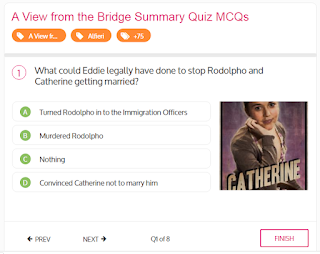
If you are looking for interactive multiple choice quizzes, I have a fav website to share with you. This website lets you create quizzes that will auto-correct student´s answers after the last question is answered. Right answers will display a green tick, wrong ones will display a red cross. This tool is intended for in-class activities, but not for assessments. There are a few public quizzes you might want to try out, then don´t miss the chance to create your own account and use it with your students.


Take an example quizz


Friday, June 17, 2016

Wizer - Interactive worksheets


Wizer is an amazing on-line interactive tool to create worksheets. Each worksheet can include open or multiple choice questions, fill-in-the-blank texts, fill-on-an-image exercises, matching exercises and tables. Each activity might include text, image or video questions. The student access is simple as sharing a link or embed code, and student´s answers are saved for teacher review.

Both teacher and student are able to create personal accounts using Goethemail´s (or any gmail account) credentials,  there is no need to remember a new username and password information. Assignments can be done to individuals or groups.

Here a few worksheets examples:


Here a couple explanatory videos:


Wednesday, June 15, 2016

Buscando un concepto IT

TIC TAC TOE


¿Qué son las TAC?
Un acrónimo frecuentemente utilizado en los contexto educativos es "TIC", Tecnologías de la Información y la Comunicación. El uso del acrónimo vino acompañado por grandes promesas revolucionarias, muchas de ellas incumplidas o pobremente realizadas. Y como pareciera que jugar con esas tres letras es atrayente, decora discursos e ilustra casi cualquier vieja propuesta disfrazada de novedad. Poco a poco, a medida que la literatura y las investigaciones serias referentes al tema han transformado la visión de educadores y tecnólogos, surgen nuevas miradas.

TIC, TAC, TEP, Es la progresión que está de moda. TAC (tecnologías del aprendizaje y el conocimiento), TEP (tecnologías del empoderamiento y la participación) resuenan hace un tiempo. En su misma definición, aparecen como transformaciones del ya viejo concepto de tecnología aplicada a un contexto y uso particulares. También existen "recetas" que combinan distintos elementos de las TAC y las TEP para devenir en ideas como "aprendizaje aumentado". Todos eufemismos para denotar una realidad, el agotamiento de un modelo tradicional que requiere de un cambio drástico.


“...el contexto sociotecnológico generen un nuevo modelo de escuela que responda a las necesidades formativas de los ciudadanos”(Castañeda, Adell, “La anatomía de los PLEs”)

Una conocida fórmula desarrollada por Jordi Vivancos en el 2009 resume el concepto TAC = "E-Learning + gestión del conocimiento", otra forma de acercarnos al concepto es la propuesta por Lozano en el 2011: "en realidad lo que se plantea es cambiar el ‘aprendizaje de la tecnología’ por el ‘aprendizaje con la tecnología’, enfoque éste orientado totalmente al desarrollo de competencias metodológicas fundamentales como el aprender a aprender".

Otros autores prefieren referirse a las TAC como tecnologías del aprendizaje colaborativo, en concordancia con concepciones pedagógicas socioculturales.  En primer lugar se considera al aprendiz como persona en interacción con su contexto y con otras personas, la premisa es asumir que compartir objetivos de aprendizaje es deseable. En segundo lugar se considera a los artefactos tecnológicos como mediadores y facilitadores del proceso de interacción. Más información en: "Construir conocimiento con soporte tecnológico para un aprendizaje colaborativo" Isabel Álvarez, Ana Ayuste, Begoña Gros, Vania Guerra y Teresa Romañá, Universidad de Barcelona, España


¿Porqué es importante definir un modelo de integración de las TAC?
La función de un modelo pedagógico es evidenciar un paradigma para entender, orientar y dirigir las acciones educativas. Es un marco conceptual, concebido a partir de un marco teórico seleccionado con el objeto de crear los contextos necesarios para que los aprendizajes se produzcan. También es un instrumento de investigación, que pone de manifiesto los valores de la cultura institucional, para la interpretación de los hechos y actos educativos que en ella ocurren. Estos presupuestos teóricos modelan qué entendemos por "hecho pedagógico" y definen criterios de acción.

Otra razón por la que es importante definir un modelo pedagógico, al interpretarlo como un sistema de valores y creencias, es la posibilidad de realizar inferencias a partir de los objetos reconocibles y sus relaciones. Inferencias que pueden ser de carácter descriptivo para explicar hechos ocurridos. Inferencias que pueden ser de carácter predictivo, con el objeto de anticipar resultados en las decisiones. ¿Qué ocurre cuando un sistema de valores y creencias no logra ser descriptivo de una realidad o no logra predecir hechos? Simplemente es descartado y posiblemente sea necesario  reemplazarlo.

La inclusión significativa de las tecnologías del aprendizaje colaborativo ha producido resultados inesperados que no han podido ser suficientemente descritos o predecidos a la luz de modelos pedagógicos ya perimidos. 


La modelación es un proceso por el cual se crean diferentes representaciones, que operan tanto en el plano teórico como práctico, con objetos reales o artificiales mediante un sistema auxiliar. Los elementos del modelo encuentran determinada correspondencia con el objeto que se investiga, y si -el modelo- es suficientemente bueno, puede incluso reemplazar al objeto real y sus relaciones para facilitar inferencias. Aquí es donde se prueba el modelo en base a su coherencia interna y a su capacidad para producir predicciones. Si esto ocurre, y se prueba la coherencia interna y las predicciones se comprueban con cierto margen de error aceptable, el modelo es considerado un sistema.

En el contexto educativo existe una curiosa proliferación de modelos propuestos para integrar TAC. Muchos de ellos parecen ser solo ensayos descriptivos de una determinada realidad, otros parecen mucho más prometedores. ¿Cuál o cuáles es ellos adquirirá el estatus de sistema? El desafío consistiría en investigar varios modelos propuestos por la prolífera bibliografia al respecto. Tal vez sea un primer paso.