Buscando un concepto EDU.IT

“...el contexto sociotecnológico generen un nuevo modelo de escuela que responda a las necesidades formativas de los ciudadanos...” Adell Castañeda

Buscando un concepto EDU.IT (parte 2)

¿Cuál es la situación actual y cuál la deseada? ¿Cómo haremos realidad un proceso de innovación?

Learn to use the Core Google for Edu apps

Google offers a free-of-cost learning center for teachers that want to learn how to use GAFE. Learn at your own pace.

Documentar los proyectos como estrategia de aprendizaje

La documentación de procesos educativos está cobrando cada vez más importancia. Pero, ¿cómo comenzar a documentar? ¿Cuáles son las primeras consideraciones?

Personal information protection

Many websites gather personal information from their visitors. Some tips for beginners.

Sunday, October 4, 2015

Data synchronization


Data synchronization technologies are designed to synchronize a single set of data between two or more devices, automatically copying changes back and forth. For example, a user's contact list on one mobile device can be synchronized with other mobile devices or computers. Data synchronization can be local synchronization where the device and computer are side-by-side and data is transferred or remote synchronization when a user is mobile and the data is synchronized over a mobile network.


Sources of information


Monday, September 14, 2015

On-Line generators. Creativity?


One can discuss whether web-generators are useful or not. On the one hand, they don’t challenge our creativity, but on the other hand they make our life easier and save our precious time. Tasks requiring subjective assessment or synthesis of complex sensory data, such as scents and sounds, as well as high-level tasks such as strategic planning, currently require human expertise. In many cases, the use of humans is more cost-effective than mechanical approaches.

The Paradox of Automation says that the more efficient the automated system, the more crucial the human contribution of the operators. Humans are less involved, but their involvement becomes more critical. If an automated system has an error, it will multiply that error until it’s fixed or shut down.

It’s widely accepted that creativity can’t be copied by machines. Reinforcing these assumptions are hundreds of books and studies that have attempted to explain creativity as the product of mysterious processes within the right side of the human brain. Creativity, the thinking has been, proves just how different people are from CPUs. 

But now we’re learning that for some creative work, that simply isn’t true. Complex algorithms are moving into creative fields—even those as nebulous as music A&R—and proving that in some of these pursuits, humans can be displaced.

Sunday, September 13, 2015

Data compression


Data compression can be lossy or lossless. Data compression is the art of reducing the number of bits needed to store or transmit data. Compression can be either lossless or lossy. Losslessly compressed data can be decompressed to exactly its original value. An example is 1848 Morse Code.

Lossy compression is a data compression method which discards (loses) some of the data, in order to achieve its goal, with the result that decompressing the data yields content that is different from the original, though similar enough to be useful in some way. Lossy methods are especially suitable for natural images such as photos in applications where minor (sometimes imperceptible) loss of fidelity is acceptable to achieve a substantial reduction in bit rate. These methods are most commonly used to compress multimedia data (audio, video, still images), especially in applications such as streaming media and internet telephony.


Lossless data compression on the other hand allows data to be fully reconstructed from the compressed data. For example, it is used in the popular ZIP file format and in the Unix tool gzip and RAR file format in the Windows tool WinRar. It is also often used as a component within lossy data compression technologies. Lossless compression is required for text and data files, such as bank records, text articles, etc. Lossless compression is preferred for archival purposes and often medical imaging, technical drawings, clip art or comics.


Information sources

Thursday, September 10, 2015

Design Tip 3 - Color Schemes Generators


A color scheme is an arrangement of colors based upon a color system, that is then applied to an illustration, design or work of art. Although most of us primarily work intuitively when it comes to making color choices, knowledge of color theory and an understanding of basic color principles can improve the appearance of an illustration. Understanding color combinations can help move an assignment along more quickly, especially when it comes to creating a coordinated series of images.


Not being a professional illustrator, I often have the need to make the right color decisions, so On-Line color schemes generators are a great place to start. These kind of generators create a set of colors based on user preferences, such as: number of colors required, color space representations (RGB, CMYK, #Hex, etc.) and many more. The most common way to use these features is to select one to three base colors and a scheme pattern, then the generator will create appropriate color combinations. The resulting individual colors in a specific combination are coded in RGB or #Hex. 

The following are a selection of the color schemes generators I usually use:

Palleton: a free color scheme generator based on most common color sets, like triads or tetrads of colors. It also offers a free style generator. A particular interesting feature is the colorblind simulator. 

RGB Gradient Maker: a gradient is a gradually increase or decrease in the magnitude of a property. RGB gradients are created by small modifications to each of the color components (Red, Green, Blue) beginning with a base color and progressing to the final color with small modifications in the gamut.  

Color Palette Generator: is a web site featuring a really interesting color scheme generator, the user will upload an image and the tool will create the color palette used in it. 


Sources of information

Tuesday, August 11, 2015

Shared Folders Linux


Select the virtual machine, click on Settings, the above window will open. Click on the plus icon to select the folder you want to share with the virtual machine. Here I share the c:\Users\...\Desktop\HostDesk (the folder names are case sensitive) on the Windows 7 to share with the virtual Ubuntu. The shared folder name is Desktop, which will be used by Ubuntu to mount it.


Once you created the share, is time to start your virtual computer in order to mount it. Create a second folder on Linux's Desktop. Now, you should have created one folder on Windows 7 desktop, and another one, on Linu's Desktop. These are the folder you'll mount together.


Open a terminal and, inside the terminal window, use the search box if necessary.   


use the following command line, replacing "HostDesk" and "LinxDesk" with the share names you defined:


Monday, August 10, 2015

Variables on Scratch


Variables are used whenever a value must be stored — i.e., if a project required the user to input a name and then remember that name, the name would be stored in a variable. With this, the name can be retrieved at any time; all the project has to do is check the value (which is the name).

The look of the variable can be changed in to three forms: The normal readout, the large readout, and the slider. The form of the variable can be changed by double-clicking or right-clicking it and selecting the option that is wanted, or clicking it using the grow/shrink sprite tool.

The following example illustrates one use of  one variable. The variable name is "Flying".


The following scripts control the value of the variable "Flying", the vertical movement of the helicopter and the land/crash speed. Two different forces are "simulated" in this really simple project: the propellers thrust (adding a positive value to "Flying") and the gravity force (constantly changing "Flying" by a negative value).


The actual movement of the helicopter is controlled by the "Change y by" block, where the standard value is replaced by the value of the variable.


Friday, July 3, 2015

Guest Additions


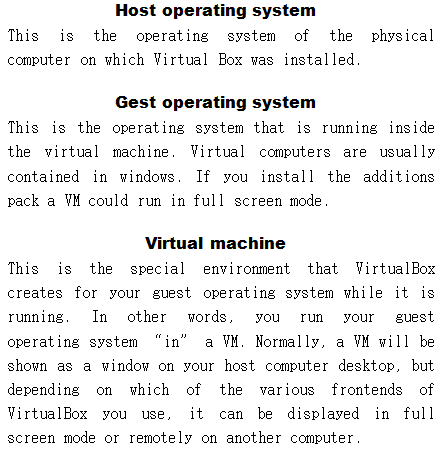
The Guest Additions are designed to be installed inside a virtual machine after the guest operating system has been installed. They consist of device drivers and system applications that optimize the guest operating system for better performance and usability. Some of the extra features are: automatic resizing, seamless mode, the bidirectional clipboard, drag and drop, and more.


Sunday, June 7, 2015

Freeze ! I´ll save your state.


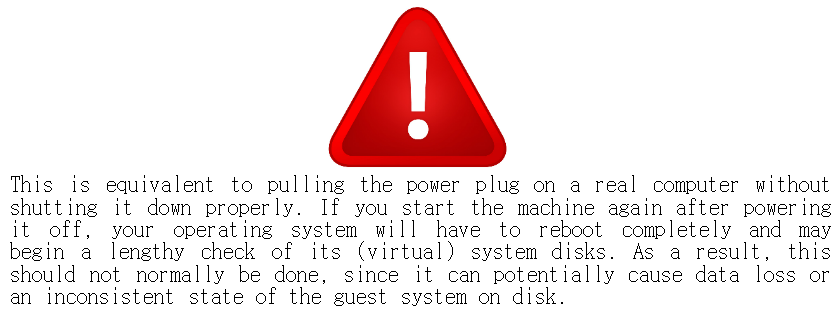
When you click on the "Close" button of your virtual machine window (at the top right of the window, just like you would close any other window on your system), VirtualBox asks you whether you want to "save" or "power off" the VM. (As a shortcut, you can also press the Host key together with "Q".)

The difference between these three options is crucial. They mean:
  • Save the machine state: With this option, VirtualBox "freezes" the virtual machine by completely saving its state to your local disk. When you start the VM again later, you will find that the VM continues exactly where it was left off. All your programs will still be open, and your computer resumes operation. Saving the state of a virtual machine is thus in some ways similar to suspending a laptop computer (e.g. by closing its lid).
  • Send the shutdown signal. This will send an ACPI shutdown signal to the virtual machine, which has the same effect as if you had pressed the power button on a real computer. So long as the VM is running a fairly modern operating system, this should trigger a proper shutdown mechanism from within the VM.
  • Power off the machine: With this option, VirtualBox also stops running the virtual machine, but without saving its state.


Friday, June 5, 2015

Blogging safety guidelines


This post article is intended to students about to open their blogs to the web and student´s parents. Blogging is a thrilling activity, many enthusiast and professional bloggers describe the experience as "life changing". For that experience to be safe, there are a number of considerations you should know about, which I´ll share with you in this post. The following content is a compilation from a variety of sources, such as experts web sites, government regulations and some schools disclaimers.

Eight safety tips for blogging (English). Download.


(Post under construction)

Thursday, June 4, 2015

Create your first VM


See the following two screencasts to learn how to create a simple VM.


Introduction to VMs


The techniques and features that VirtualBox provides are useful for several scenarios:
Running multiple operating systems simultaneously. VirtualBox allows you to run more than one operating system at a time. This way, you can run software written for one operating system on another (for example, Windows software on Linux or a Mac) without having to reboot to use it.

Easier software installations. Software vendors can use virtual machines to ship entire software configurations. For example, installing a complete mail server solution on a real machine can be a tedious task. With VirtualBox, such a complex setup (then often called an "appliance") can be packed into a virtual machine.


Testing and disaster recovery. Once installed, a virtual machine and its virtual hard disks can be considered a "container" that can be arbitrarily frozen, woken up, copied, backed up, and transported between hosts.

Snapshots and saved machine states. On top of that, with the use of another VirtualBox feature called "snapshots", one can save a particular state of a virtual machine and revert back to that state, if necessary. This way, one can freely experiment with a computing environment. If something goes wrong (e.g. after installing misbehaving software or infecting the guest with a virus), one can easily switch back to a previous snapshot and avoid the need of frequent backups and restores.

Infrastructure consolidation. Virtualization can significantly reduce hardware and electricity costs. Most of the time, computers today only use a fraction of their potential power and run with low average system loads. A lot of hardware resources as well as electricity is thereby wasted. So, instead of running many such physical computers that are only partially used, one can pack many virtual machines onto a few powerful hosts and balance the loads between them.

Monday, June 1, 2015

Scratch project nro. 1

Lets create a maze ! Numerous mazes of different kinds have been drawn, painted, published in books and periodicals, used in advertising, in software, and sold as art.


A maze is a tour puzzle in the form of a complex branching passage through which the solver must find a route. The pathways and walls in a maze are fixed, and puzzles in which the walls and paths can change during the game are also categorized as tour puzzles. The Cretan labyrinth is the oldest known maze.

Creating a maze game on Scratch is easier than you might think. You only need the following instruction set for a basic gaming experience:


  • One character to go through the maze. I suggest you replace the cat with another funny character. 
  • To control your character movements, I suggest two options: add four arrows pointing in up, down, right and left directions; or control your character using the arrow keys on the keyboard. For more advanced users, try to develop both options.
  • Insert a maze image in your stage. Depending on whether option to control your character you selected, a blank space on the stage will be needed. 
  • If your character touches any wall, you loose. If your character reaches the exit, you win. 


Some blocks you´ll need